Monday, July 15, 2013

Die maan lê op sy rug.


Fires every night, drawing water from the well and heating it in an old battered kettle, washing ourselves with a cloth, a pitcher and a bowl. Lighting all the lamps.


We watched a satellite zoom between venus and the moon. And Sylvie told us stories. She speaks with the soft rolling r's of the West Coast and an old-fashioned turn of phrase.
Sowaar, altemit, eertyd se mense.

She says that when the moon lies on his back, the weather will change, and so it did.

Sylvie was born in this house and she married and had five children here. She remembers a man in the village shooting boats-full of flamingos and distributing them to everyone for flamingo curry. Tortoises made into stew... Her husband now lies in the cemetery in Churchaven, a huge aloe on his grave. She remembers that when he was courting her, (vlerksleep), he went to pick her some cherry tomatoes in one of the vegetable gardens, only to find a puff adder hissing under the bush. He worked on the whaling boats and often they wouldn't see him for months. She went to visit him one Christmas - in Tenerife. In the time when there were no roads here. Her son phoned her last week to get a recipe for fish stew. And then asked how to get the power of the fish. Die krag van die vis. Cooking the bones for stock.


Beach combing, hunting for porcelain shards, date loaf on the stoep. An old man fixes fishing nets just down the hill. The francolins wait at the kitchen door for breakfast and take baths in the dust.
In the evenings, Sylvie's brother and some friends join her to watch Sewende Laan. They play rummy and talk and laugh until nine. The chatty honking of the flamingos carries on through the night.


Every time we go there, it is harder to leave.

Monday, July 8, 2013

Favourites.

I have been back for a week... but thoughts of another city still fill my head.
I'm taking flight again tomorrow - while I can - to the seaside.
To that wonderful house where the door has no key.

There is a date loaf in the oven and the house is filled with swoonworthy smells.
Lazy lazy.


Thursday, July 4, 2013

Jozi Love.


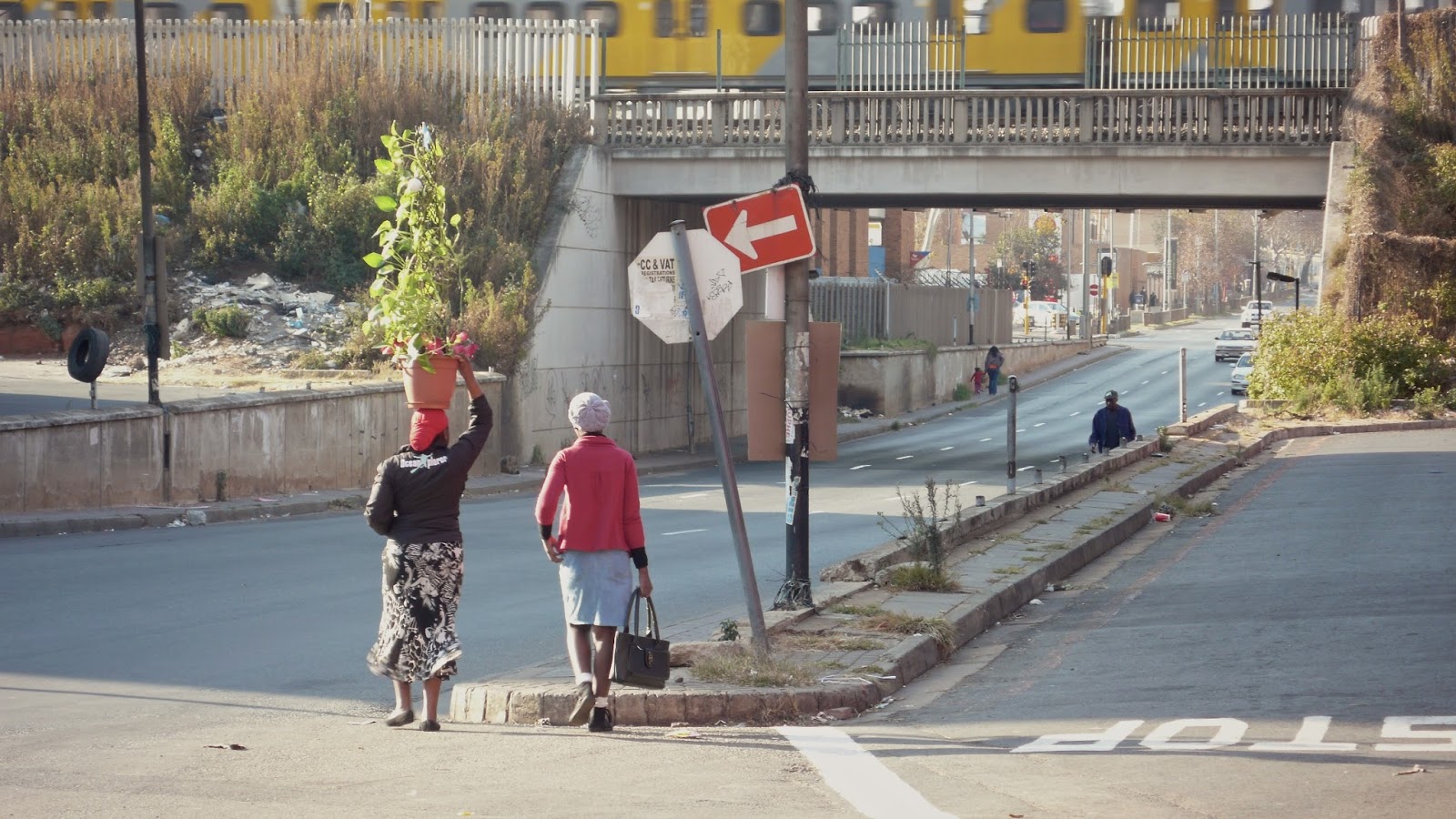
Johannesburg is a city of glaring contrasts. Abject poverty and extreme wealth sit right there next to each other, rubbing shoulders. Everywhere, even in the best areas, the city is crumbling. Cavities in pavements speedily fill up with garbage. Missing manhole covers present rungs leading stories-deep into the underworld. (Yet girls skip around in sky-high stilettos, oblivious.)


Everywhere we went, we were either treated with friendly curiosity, or ignored completely. We went to places where a shop could be a small brazier on the pavement, with a couple of kebabs. Or a piece of cardboard with five packets of cigarettes. Tailors, hairdressers and cobblers. Constant industry. Very, VERY little begging.


The city is broken, but it works.


Tuesday, July 2, 2013

Angry schoolgirl.


She turned her head an instant before I took the photograph.
"You DID NOT just take my picture!"
"Uhmm no, just the graffiti..."
And with a toss of her head she climbed onto the bus and it sped away.

Sunday, June 30, 2013

Coming home.

We travelled through mining country. We travelled through cattle country. Anthills and Acacias. Columns of smoke from veld fires listing to the left. The rusted zinc roofs of small towns, their names ringing strangely in the mouth. Klerksdorp, birthplace of my father, who is long gone. Wolmaranstad, Leeudoringstad, Makwassie and Sewefontein. Brahman and stately Nguni: bred, advertised and auctioned.
Sterkfontein, Geluk, Vuurfontein and Christiana. Underneath this red earth: gold, diamonds and uranium.
We crossed the Vaal and then the Orange River. Mighty rivers of geography classes. The dam on the outskirts of Kimberley was choking, pink with flamingos. A thousand flower petals on the water.


We camped by the waterside at Mokala. Just in time to see a herd of Black Wildebeest drink.

There is give and take when you share an open space with others. The long legged man and I go quietly through the world. So it was that we were placed next to a louder species. With tread plate on their bonnets and flaps that lifted to reveal all manner of gadgets. Roof tents and headlamps and Intex and zips.
Many, many zips.

A free broadcast of other lives. Grant and Ludwig and their girlfriends Baby and Baby discussed their dinner (steak, bread and potatoes with Woolworths onion jam). What they needed to shop for the next day (Grant wanted some Amarula Cream Liqueur for Baby - "the Spirit of Africa". Baby needed a hairbrush.) What they would eat for lunch (leftover steak and sweet chilli sauce sandwiches.) And then, for an interminable time, Grant and Ludwig discussed tyre pressure, rims, axels...
The Babies were speechless.

We heard an expelled breath and a rustle in the undergrowth. You forget how large a porcupine is.
As we settled in for the night, there was a smack of animal lips and the crunching of a bone.

New school, old school.


I hadn't seen a giraffe in many years.
I blinked back a tear.
Then, a family of bush pigs awoke the carnivore in me. I dreamed up a side dish of pears and fennel, cooked ever so slowly.

Early morning zebra, Karoo National Park.
As you enter the towns, there are peeling old billboards, beseeching the faithful.
Somewhere between Heuningneskloof and Salt Lake, we came upon an abandoned church.


Consecrated in 1901, it now stands forgotten next to a wind pump. In a nearby field a cast iron bed slowly rusts. The church door is held shut with a big rock.


Next to some ruins, I picked up and old enamel cup, corroded and patterned with roses.

Douglas - place of confluence and pioneer seed.
Elim, Irene.
Small grey monkeys on bridges, and communal living for sociable weavers.


They come in different shapes and sizes, some so heavy that the telephone poles sag.
Things you miss and wonder about, when you fly.

Prieska and Britstown. Past the dolorite hills of Three Sisters we made haste. Victoria West, Beaufort West and Prince Albert and the world turns green again. The mountains are impossibly blue, shades of cornflower, of hyacinth and lobelia. A thick sifting of snow. The fynbos blooms deep purple.

My boots covered in dust,
I am home.

Tuesday, June 25, 2013

The gleaners.

I was standing under a bridge in Jeppestown when I noticed them for the first time. It was a Monday morning. A tall young man in a green balaclava whizzed past, riding his platform trolley like some kind of giant skateboard, his coat flapping like a cape. I caught his eye and even though his mouth was hidden, I could see him smile. He was around the corner before I could lift my camera and focus. And then, all of a sudden, they were everywhere. Sorting and washing and packing.


And waiting in a line that stretched around the block.


All the way to the entrance of Motech Recycling, at number six Staib Street, New Doornfontein. We hung around there for a while, wondering and speculating.

Eventually a large, shirty security guard offered to call someone, instead of "you taking all these pictures". We went up to the office and spoke to Kashif, the MD, and his right hand man, Duke. They were open and helpful and rather lovely. Apparently, it's a quiet time right now. They take in about 15 tons of recycling every day. In Summer it goes up to 35 tons a day. 35 tons! And Motech is only one of three large recycling buyers in greater Johannesburg.

In effect, hundreds of people, previously destitute, now have a means of making money every day and they are making an incredibly dirty city a much cleaner place. And Motech has no responsibility towards these gleaners - they just buy what is brought right to their front door. What a business!


I'm impressed, shocked and fascinated.